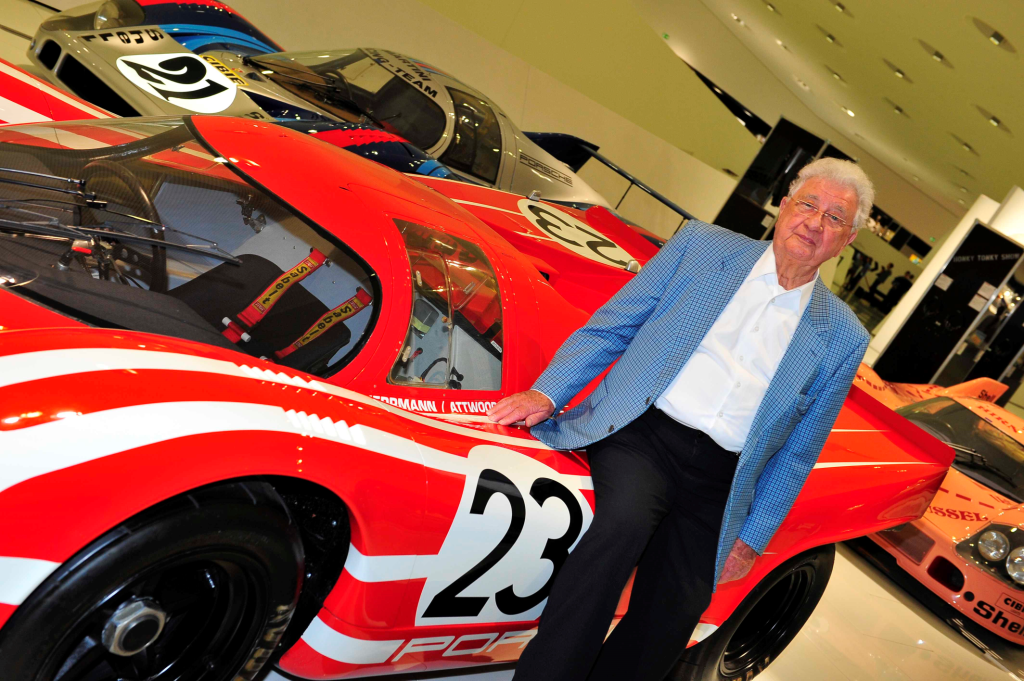
The death of long-time Grand Prix Drivers Club member Hans Herrman, only a few weeks before his 98th birthday, is a sad moment for the Club. Hans and his wife Magdalena, were regular attenders at the Club events.
He and Magdalena always brought a touch of fun and amusement but we will always remember his remarkable career in racing, which, though mainly concentrated on Porsche, saw him as the choice by Mercedes-Benz as one of the drivers in their successful Formula one and Sports Car teams in the 1950s and he was to be successful not only in those disciplines but also in International hill climbing with Borgward and Abarth.
If motor racing had not intruded, the young Hans was destined to become a baker, as his father had been murdered and his mother had opened a coffee shop, and he apprenticed as a pâtissier, the plan being for him to eventually take over the shop from his mother. However, this was not to be: “When I was young, most of my friends wanted to be pilots, ship captains or train drivers, but my dream was to be a racing driver, and my heroes were Bernd Rosemyer and Rudolf Carraciol, the stars of the pre-War Auto Union and Mercedes-Benz teams”.
When I once asked him about his culinary skills, he laughed: “…. I can’t bake!”
His entry into racing came in 1952 when his mother gave him her gold bracelet to sell so that he could buy a second-hand Porsche 356. With it, he took part in his first event, winning his class in the Deutschlandfahrt (Tour of Germany) and later running in the Hessen Winter Rally. In 1952, he ran the Porsche in a production car race at Nurburgring and won.
In 1953, he put a 1500cc engine in his Porsche and won his first race at the Nurburgring with the car in heavy rain. He was then drafted into the Porsche team for Le Mans in one of two Porsche 550 Spyders fitted with hard tops. It had been found in testing that on the Mulsanne Straight, the car hit 124 mph, but without the hard top, it was slower. In the race, the Porsches were running well and finished first and second in the 1500cc class. Richard von Frankenberg and Paul Frere were declared first in the class after the organisers checked their figures with Hans Herrmann and Helm Gloeckler second.
Later that year, Hans was invited by Porsche to race in the Pan-American Road Race, again with a Porsche 550. That year, the team was sponsored by Wendell Fletcher of Fletcher Aviation in the USA, who had a licence to use Porsche engines in the light planes they were building. In that race, Hans led the event at the end of the first stage but later crashed when his steering arm broke. The following year, 1954, he was to finish 3rd overall, a giant-killing performance.
1953 saw his closest escape from death in the Mille Miglia, where he was driving with Herbert Linge in a Porsche 550 Spyder. Near Pescara and the village of Rieti, Hans came round a corner at about 90 mph to be faced not only by a railway level crossing but with the bar lowering down. He could see the train coming but couldn’t stop, so he accelerated and tapped Linge on the shoulder as they both ducked, dashed under the barrier and made it to the other side.
However, 1954 saw him being chosen to drive a third Mercedes-Benz when the Stuttgart concern came into Formula 1 with the famous streamlined F1 car. Initially, Mercedes planned to enter Formula 1 with just two cars but then came a decision to run a third and a test session was arranged at Nurburgring and a group of young drivers including Hans, Paul Frere and Hans Klenk another young German who had let Hans race his Veritas sports car in events, had the test and it was Hans who proved to be the fastest and was chosen.
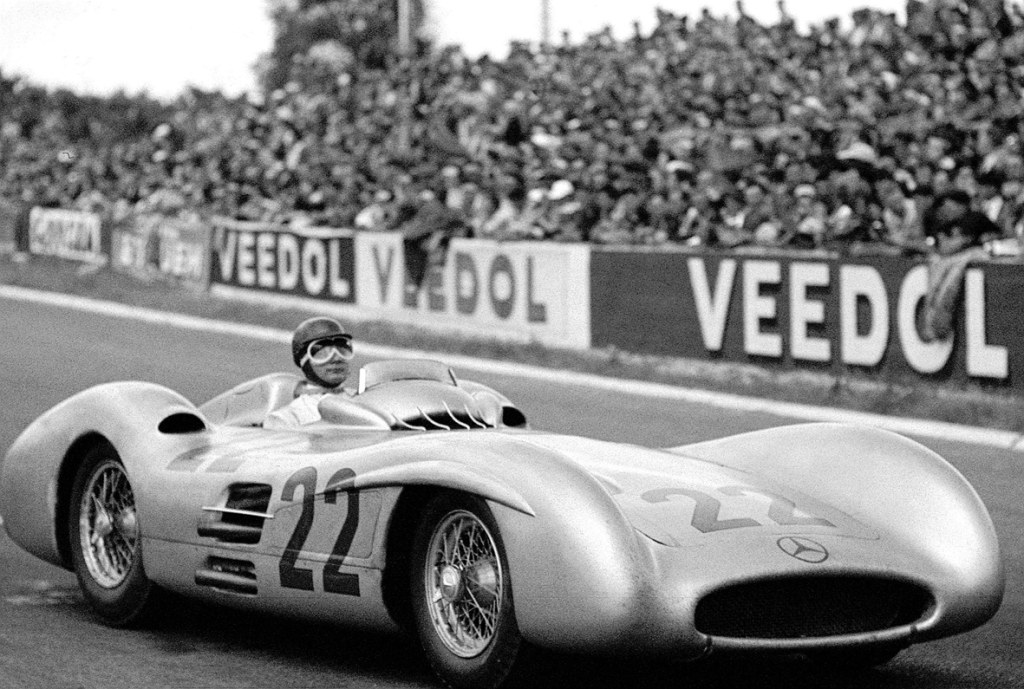
Driving the 300SLR sports car in the Mille Miglia, various modifications were made to the 300SLRs to withstand the strain on the chassis and components. In the race itself, Hans caught up with Fangio, who had started six minutes ahead of him. Stirling Moss was driving like the wind, and at Pescara, he was running fifteen seconds behind the leader, Piero Taruffi in a Ferrari, with Herrmann third. By the Rome control, Stirling Moss was in the lead, as in the previous fuel stop, he had saved time by taking on just enough fuel to get him to Rome.
Hans then had the throttle jam on his ca,r but was able to free it and get to Rome where it was repaired. However, at the Rome stop, Herrmann refuelled and continued, but on the Futa pass, the fuel cap came loose on their car, soaking Hans and Hermann Eger in fuel. Some got into Hans’ eye, and he spun the car and damaged it, but as soon as it stopped, they both jumped out in case it burst into flames. They walked to the next village and found a small hotel where they got out of their soaking racing overalls and borrowed pyjamas.
As Hans explained, “…. During the race I had tried to look after my brakes as I knew Stirling Moss would be hard on his brakes. Our times were similar on the stages, and my hope was that Stirling would have trouble with his brakes after the Futa and Raticosa passes, and I might have a chance to overtake him, but that loose fuel cap from the Rome stop finished our race”.
In the Monaco Grand Prix, Hans crashed, heavily injuring his back and he retired from Formula 1 but at the end of 1956, he was looking for a drive. He was brought back into the Porsche team and returned to racing at Sebring, where he was paired with Wolfgang von Trips in a 550 Spyder.
However, for the Targa Florio, he was entered with Olivier Gendebien in a Ferrari 290 MM, his first race in a Ferrari. In practice, he was not used to having a throttle pedal in the centre and ended up rolling the car. However, the team had a spare 860 Monza Ferrari, and they finished fourth overall.
Obviously, Herrmann wanted to return to Formula 1 in 1957, but all the leading teams were fixed up. He was still involved with Porsche in World Championship events, but in April, he was offered a drive with a Scuderia Centro Sud Maserati 250F at Syracuse. It was not very well prepared, and he eventually had to retire with a very sick engine. More trouble was to follow at Monaco, where Maserati entered him in a factory 250F, but he did not qualify.
In 1958, he only had three drives in Formula 1, again in Maserati’s, but with no results. At the same time, he lost his drive in the Porsche factory team – save for Le Mans. “Huske von Hanstein, the team manager and I had a difference of opinion as he preferred to have Wolfgang von Trips driving for him, but I was approached by Borgward to race their 1500 sports cars in races and hill climbs. Later, von Trips told me that I should have offered him (Von Hanstein) some money!”
At Le Mans, Porsche paired Hans with Jean Behra, and they were to finish third overall with one of the new Porsche RSKs. This did a lot to re-establish Hans with Porsche, and he was to continue to race with them in sports cars for the rest of his career.
His 1959 Grand Prix season was again pretty miserable with two retirements. The first was in the British Grand Prix with a Centro-Sud Cooper-Maserati, and the second, more spectacularly, when he crashed the BRP BRM P25 at Avus. Luckily, he was thrown out of the car and watched as the car destroyed itself. He briefly had a season in hill climbs with Abarth
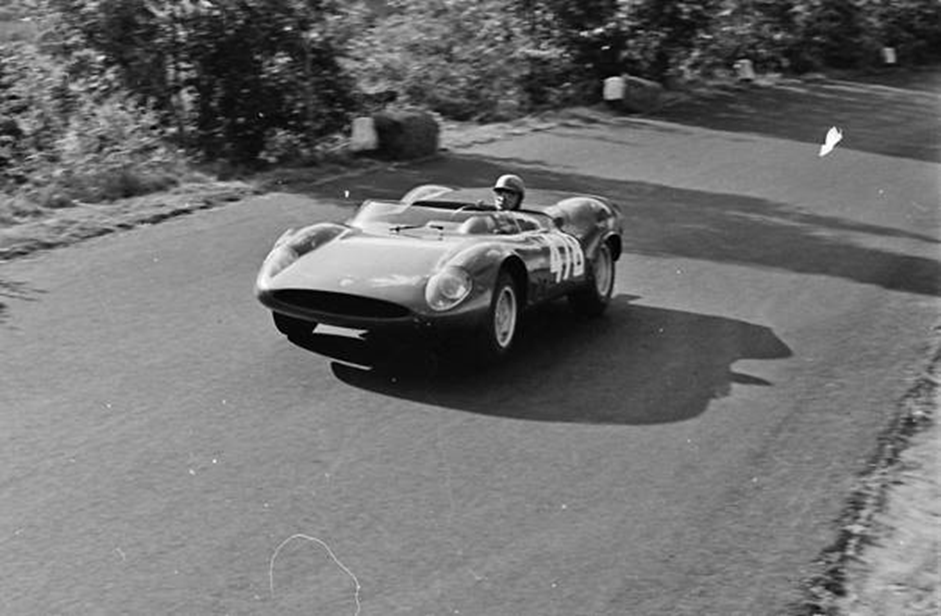
During the 1960s, Hans Herrmann continued to drive for Porsche but was also free to race for Abarth, and so was in the unique position to compare the two cars. In 1965, in particular, he ran in the European Hill Climb Championship with Abarth, but it was a season dominated by Ludovico Scarfiotti with the new Ferrari Dino. “I found that the Abarth was not an easy car to handle, but it had a powerful engine and was actually easier to drive on power than the Porsche. In the hill climb events, I decided not to extend myself in practice but to save some power for the event itself, and it seemed to work. However, at one hill climb I decided to change tactics and drove as hard as I could in practice, and von Trips crashed trying to equal my time”.
By the end of the 1960’s Porsche brought out the legendary 917 turbocharged sports car. They came to an agreement with John Wyer Racing to run Porsche 917s in the World Sports Car Championship with sponsorship by Gulf Oils. However, there was a second Porsche 917 team run by Porsche Salzburg and owned by the Piech family, and Hans was signed by Porsche Salzburg that season. Hans had also promised his wife Magdalena that if he won Le Mans that year, he would retire from racing.
The 1970 Le Mans was the first one to be run with the drivers strapped into their cars and not running across the road for what was called a “Le Mans start”. The man who dropped the flag to start the race was Ferry Porsche himself, which may or may not have been a good omen.
Almost from the start, it rained and rained. At the end of the first lap, the Hans Herrmann car was in ninth place, and he and Attwood kept a steady pace and watched as the Gulf Cars retired along with the favoured Ferraris. Finally, near the end of the miserable 24 hours, Hans had decided that he really would retire after the race.
At 4.00 pm on the Sunday afternoon, Herrmann and Attwood crossed the line in their red Porsche 917L and gave Porsche their first outright win at Le Mans, capping a career that had had its ups and downs but was marked by consistency.
Hans Herrmann retired, but not to a quiet life, as his motor parts business was expanding and needed his attention. In the 1990s, however, he and Magdalena were faced with a drama greater than anything he had faced in racing.
Arriving home one evening, they disturbed three masked men in the house. Hans was grabbed, and his hands were tied behind his back. He was led to the cellar, and his wife was told that the gang wanted 6 million German marks to release Hans! The next day, Hans was put into the boot of his own Mercedes and driven to an autobahn service area whilst his wife was taken to the bank and withdrew the money. Once the kidnappers had the money, they told Magdalena where they had parked Hans’ car.
She phoned the police, who rushed to the service station and released Hans, but the robbers were never caught!
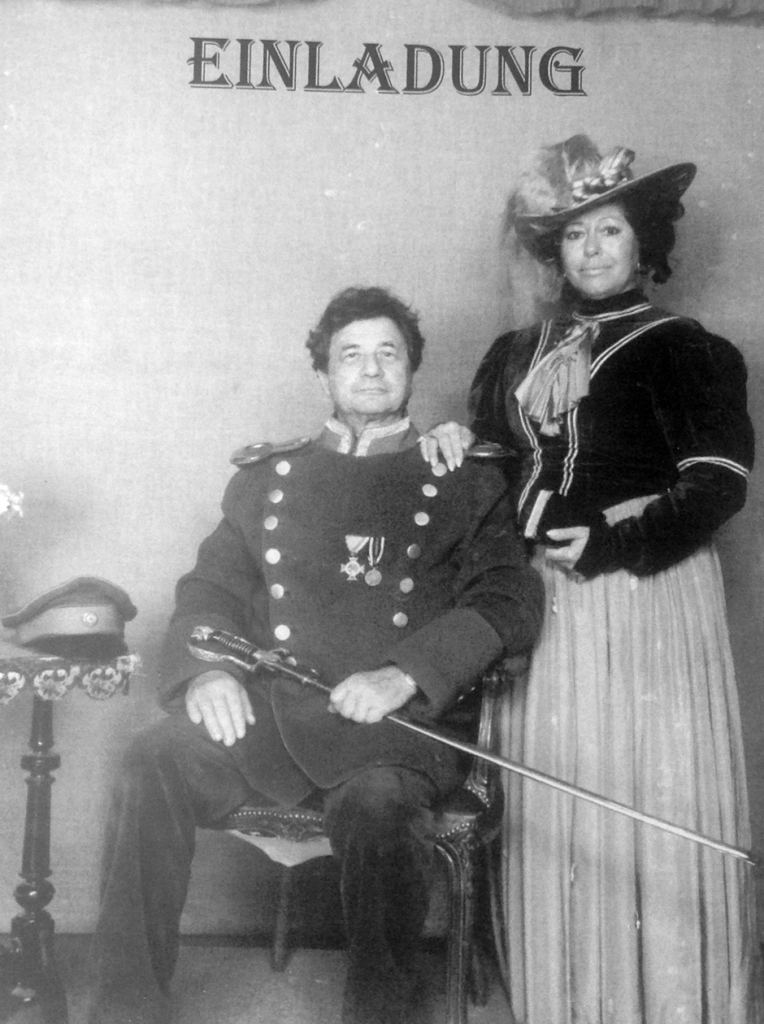
Hans Herrmann was an important member of the Grand Prix Drivers Club, and he and Magdalena enlivened many of our meetings, so it is perhaps appropriate to publish this amusing photo of them dressed up in style for a celebration, and the Club sends its condolences to Magdalena and the rest of his family at their great loss.
Graham Gauld