Of all the Formula 1 drivers who became World Champions, Alan Jones is probably the least well known. He never promoted himself but was one of the toughest racers when it came to a Grand Prix.
He was easily persuaded into motor racing as his father, Stan Jones, was one of the most successful racing drivers in Australia with an equally successful business as a major Holden dealer in his native country.
Those of us old enough to remember Stan Jones recall his exploits with various Maybach Specials and then a 250F Maserati in Libre events, so it was no surprise when his son Alan started racing in karting and then with his BMC Mini before graduating to the Cooper T51/T53 Cooper Climax, which his father raced in the early 1960s.
All of this stopped when the Holden dealership got into difficulties and was sold, but Alan decided to make the familiar route for Australian drivers to travel to England.
To finance his racing in Formula 3, he went round buying and selling cars in order to buy his Formula 3 Brabham, which he ran alongside his Australian friend Brian McGuire.
For Formula 2 he signed up with Scotsman Denys Dobbied’s DART team for the 1973 John Player British Championship but that ended when DART pulled out of Formula 2 so it was left to Harry Stiller to step in and offer Alan a drive in Formula Atlantic.
His breakthrough came with a one-off drive when John Macdonald gave him the seat in the Chevron B24 he had just bought in time for the last round of the Rothmans F5000 Championship at Brands Hatch, where he surprised everyone by qualifying ninth and finishing 12th in his first F5000 race.
Harry Stiller went on to buy one of the Hesketh Formula 1 cars for 1975 with Alan Jones as the driver, but he had bad luck in the first three Grands Prix, once by losing a wheel and twice by being nudged into retirement by Mark Donohue and Jacques Laffite. Graham Hill then signed Alan for his Embassy Racing team partway through the season, and he finished fifth in the German Grand Prix at the Nurburgring.
John Surtees then brought Alan into his team for 1976, driving the TS19 and demonstrating his potential with an impressive 4th place in the final round at Suzuka, but it was with Don Nicolls Shadow that he won his first Grand Prix at Österreichring and ended seventh overall in the drivers championship.
He was then to drive for Frank Williams in 1978 and 1979, and he took four wins with the Albilad-Saudis Williams FW03 to finish third overall in the drivers’ championship. He stayed with Williams in 1980 and immediately won the Argentine Grand Prix and went on to win another four Grand Prix races for TAG-Williams and be crowned World Champion.
He stayed with Williams in 1981, and his last Grand Prix win was on the Caesars Palace street circuit with the FW07C, before announcing his retirement from racing at the end of the season.
He returned to Australia but kept his hand in racing Porsches before making a return to Grand Prix racing in 1983, driving an Arrows in the Race of Champions and his full Grand Prix debut at Caesars Palace in March but he retired and left the team over contract difficulties.
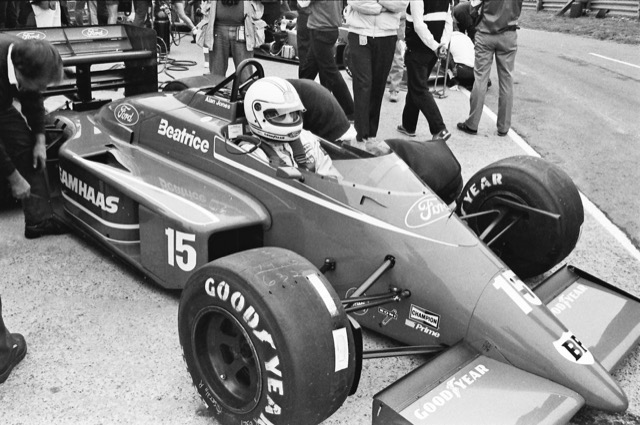
He surprised everyone by coming back in 1985 to replace Mario Adrettti in a CART race at Road America and then signed with the new Haas Grand Prix team, but it was a disaster as he retired in three of his four races with mechanical problems. He stayed with Hass in 1986, and despite taking fourth place in Austria, he was to retire the car in 12 of the other races that season and walked away from Formula 1 at the end of the season. He returned to Australia to run in the V8 Touring car championship firstly with a Ford Sierra and later a BMW M320. He ran two Ford Falcons in 1993 with backing from Marlboro.
Alan Jones will always be remembered for his forceful driving and dogged determination. He has been a member of the Grand Prix Drivers Club for many years, and the President, Emanuele Pirro and members send their condolences to Alan’s family